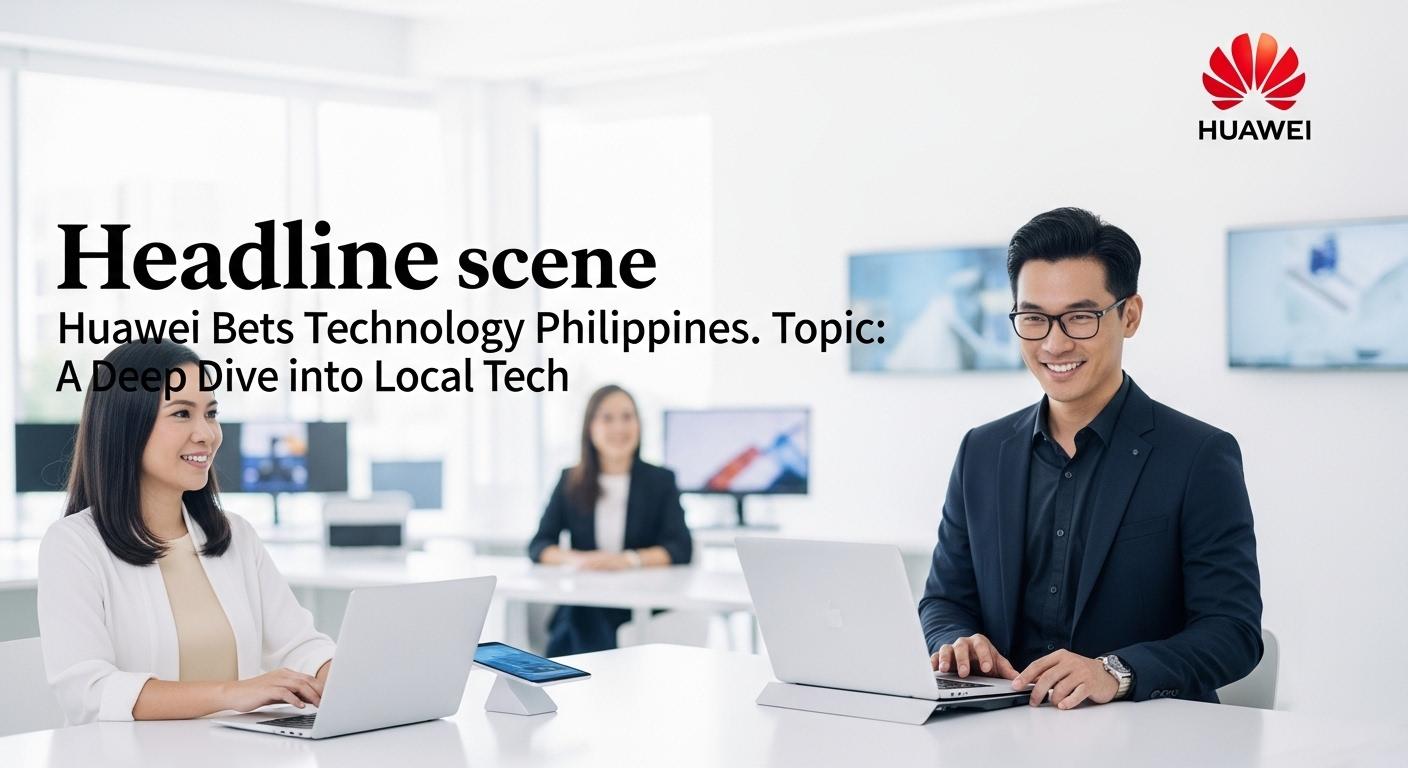
Editorial visualization of Huawei technology investments and the Philippine data-center landscape.
Updated: March 16, 2026
In the Philippines, bets Technology Philippines is shaping how policymakers and businesses weigh Huawei’s next moves in a market hungry for data resilience, edge applications, and digital inclusion. As the country accelerates its digital economy, a debate is taking shape over who builds the critical infrastructure—data centers, fiber backbones, and smart-utility networks that power everything from health tech to micro-fulfillment in city corridors.
A Philippine Tech Landscape at a Crossroads
The Philippines sits at a unique intersection of rising demand for cloud and edge services and a patchwork of energy costs, grid reliability, and regulatory frameworks. Local startups push for faster, cheaper access to compute resources; government programs aim to accelerate digitization of public services; and multinational tech players eye the archipelago as a southeastern hub for data processing in a climate of regional competition. The decision to expand data-center capacity isn’t only about square footage; it’s about energy intensity, cooling costs, and the ability to deliver low-latency services to consumers and enterprises across Luzon, Visayas, and Mindanao. In this environment, the country is less a passive recipient of technology than a testbed for how resilient, localized tech ecosystems can evolve under tropical heat, variable weather, and evolving privacy norms.
Huawei’s Philippine Strategy and Local Data-Center Push
Observers note that Huawei—like other global hyperscalers and telecom players—appears to be calibrating its moves with the Philippines’ growth trajectory in mind. The central questions revolve around data localization, security assurances, and the feasibility of energy-smart designs that can withstand Manila’s humidity and occasional heat spikes. While no definitive public commitments are announced, interviews with industry insiders suggest a potential alignment with Philippine goals to diversify data hosting and reduce latency for public-services and consumer platforms. The bottom line: any Huawei-backed data-center push would hinge on clear regulatory guardrails, local talent pipelines, and practical partnerships with Philippine firms to ensure reliability, supply-chain stability, and transparent governance. This is not just a technology story; it is a policy and planning story about how foreign investment adapts to domestic priorities.
In parallel, the Philippines faces a climate- and cost-driven cost curve for cooling and energy use. A recent analysis in regional tech media highlighted the heat challenge of running data centers in tropical environments and stressed the importance of energy efficiency measures, from modular designs to ambient-cooling strategies. The interplay between heat management, electricity pricing, and grid stability will shape the economics of any Huawei-backed facility—and thus influence the speed at which such projects proceed or stall.
Infrastructure, Energy, and Regulation
Any credible PH data-center expansion must reckon with two intertwined realities: the energy backbone and the regulatory frame. The grid in many parts of the country remains vulnerable to outages and price volatility, making resilience a prerequisite for data-center uptime requirements. Cooling systems—whether using water-cooled racks, immersion cooling, or air handling optimized for humidity—are not cosmetic choices but core cost drivers and environmental considerations. Policymakers face the challenge of aligning incentives for investment in renewable energy, energy storage, and grid modernization with the demand for data sovereignty and security. In practice, this means transparent permitting processes, predictable tax and land-use rules, and defined standards for vendor qualification and cybersecurity. A pragmatic approach would encourage modular, scalable facilities that can expand with demand while minimizing energy waste and peak-load penalties.
For Huawei and any local partner, a successful deployment would require not only capital but local capability: skilled technicians, supply chains for critical components, and ongoing collaboration with Philippine regulators to ensure that infrastructure aligns with national digital ambitions and consumer protection commitments. In short, the road to robust technology uptake in the Philippines is as much about governance and energy strategy as it is about hardware and software.
Actionable Takeaways
- Policymakers should establish clear data-center guidelines that cover localization, cybersecurity, and energy incentives, reducing uncertainty for investors while safeguarding national interests.
- Private sector players, including Huawei and local partners, ought to invest in energy-efficient cooling, diversified energy sourcing, and modular data-center designs to scale with demand and weather realities.
- Telecommunication and cloud providers should collaborate on fiber backbones, edge-computing nodes, and disaster-resilience planning to ensure reliable services across islands and urban centers.
- Talent development and local supply chains must be prioritized to build sustainable capacity, reduce dependence on imported components, and foster long-term growth in the tech ecosystem.
- Media and analysts should monitor regulatory developments and publish independent assessments of infrastructure projects to provide balanced viewpoints on risks and opportunities.