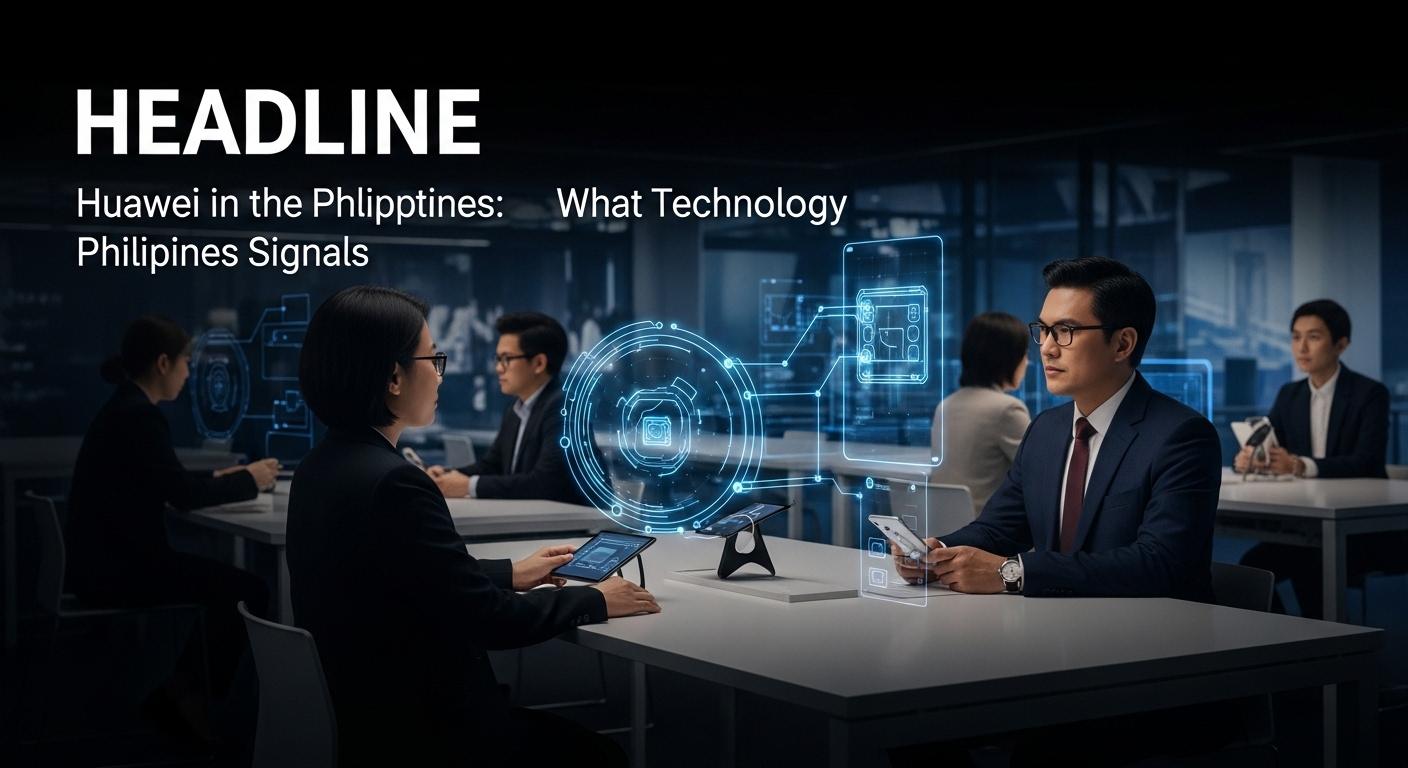
Editorial illustration of Huawei influence in the Philippines tech scene, with AI and 5G visuals.
Updated: March 16, 2026
In the Philippines, Huawei seeks to anchor its regional comeback through a careful mix of local partnerships, government-aligned pilots, and enterprise digitalization projects. The push hinges on new ties with domestic firms such as kerr Technology Philippines, which the company envisions as a bridge to local capacity, regulatory compliance, and customer resilience.
Why the Philippines matters for 5G and Huawei’s regional ambitions
The Philippine market sits at a strategic crossroads for Southeast Asia’s digital transformation. With two major mobile operators pushing into higher-speed networks and a government intent on accelerating e-government, cloud services, and industry digitization, the country presents a test bed for both legacy connectivity solutions and next-generation deployments. For Huawei, the appeal is twofold: access to a large, young consumer base demanding reliable mobile and consumer services, and a growing enterprise segment that seeks scalable, secure network and cloud capabilities for manufacturing, logistics, and agriculture. Yet the Philippines also poses distinct challenges—geographic fragmentation across thousands of islands, variable infrastructure in rural areas, and a policy environment that increasingly prioritizes security, resilience, and local capacity-building. Against this backdrop, Huawei’s strategy in PH hinges not only on technology refreshes but on aligning with local actors who can translate global capability into locally sustainable outcomes.
The presence of local systems integrators and service providers is not merely a procurement footnote. It influences how quickly networks can be upgraded, how effectively data sovereignty concerns are addressed, and how service ecosystems mature around 5G-enabled applications. In this context, the role of kerr Technology Philippines, as described in industry discussions and by Huawei’s regional teams, becomes more than a marketing liaison. It is a case study in how multinational vendors seek to anchor themselves in complex markets by integrating with homegrown firms capable of navigating procurement cycles, talent development, and regulatory nuance.
The Kerr Technology Philippines angle: local partnerships and capacity building
Local partnerships in telecom and IT infrastructure are increasingly viewed as essential for durable market presence. A firm like kerr Technology Philippines can offer more than installation services; it can deliver local talent pipelines, certification programs, and post-implementation support that align with Philippine standards for data handling, privacy, and security. Such partnerships help mitigate supply-chain risks, speed up rollout timelines, and provide a channel for continuous feedback between end users and equipment providers. In turn, Huawei benefits from a more predictable deployment cadence, a higher degree of localization in maintenance and operations, and a clearer path to scaling 5G services into business sectors such as logistics hubs, smart ports, and manufacturing zones. The synergy rests on shared objectives: translating global technology into Philippine-specific outcomes, while ensuring that the workforce and governance frameworks keep pace with technological change.
For kerr Technology Philippines, co-creating solutions with Huawei may entail tailored training programs for technicians, project management offices that align with PH procurement rules, and a local data-handling protocol designed to satisfy both business customers and regulatory expectations. The broader implication is a model for how foreign tech ecosystems can be made more durable by embedding early, ongoing talent development and localization obligations into commercial deals. If executed well, such a model could set a precedent for other multinational vendors seeking to anchor in the archipelago while supporting domestic IT capacity-building and job creation.
Policy, security, and resilience: risks Huawei faces in the Philippine market
Security concerns and procurement governance increasingly shape how telecom players select partners and deploy new networks. In PH, policymakers emphasize resilience, critical-infrastructure safeguards, and transparent vendor selection processes. That environment naturally places scrutiny on any single-vendor approach and elevates the value of diversified ecosystems where local partners can verify compliance, system interoperability, and incident response readiness. Huawei’s presence in these conversations is shaped by evolving data sovereignty expectations, localization commitments, and the openness of regulatory processes to new entrants. While a robust 5G upgrade often requires a bouquet of vendors and platforms, PH authorities also seek assurances that networks can withstand disruptions, whether from natural events, cyber threats, or geopolitical frictions. For Huawei, this dynamic means prioritizing security-by-design, open standards, and close collaboration with partners like kerr Technology Philippines to demonstrate that local teams can operate complex networks with appropriate oversight and governance.
Another facet of risk involves supply-chain stability and the capacity to deliver end-to-end solutions without excessive lead times. In archipelagic markets, even a minor delay in components or services can ripple across multiple islands and industries. Proactively building local capabilities—through training, certification, and regional support hubs—can mitigate that risk. However, it also requires sustained investment and clear governance around data workflows, on-site vs. cloud-hosted services, and cross-border data movement. In this sense, the Philippines tests not only technology choices but the maturity of a vendor ecosystem that can responsibly steward digital modernization while meeting public interest obligations.
Scenario framing: plausible futures for Huawei and Kerr in PH
Four plausible futures help illuminate practical decision points for policymakers and industry players alike:
- Progressive integration: Huawei expands beyond consumer devices into enterprise and public-sector deployments, with kerr Technology Philippines serving as a trusted integrator and local mentor for workforce development. The regulatory environment remains stable, enabling a steady cadence of pilots and scale-ups in logistics, manufacturing, and smart-city initiatives.
- Security-forward market: PH authorities implement enhanced security and localization requirements, encouraging joint ventures that emphasize transparent procurement, data residency, and robust incident-response capabilities. Huawei adapts by increasing local staffing and governance layers via Kerr and other partners, ensuring accountability and continuity.
- Diversified vendor ecosystem: The government and telcos push for vendor diversification to reduce systemic risk. Huawei remains a core supplier for non-core services while Kerr-led local teams manage critical operations, localization, and after-sales support, creating a resilient mixed ecosystem.
- Disrupted supply chains: External shocks or policy shifts constrain supply chains or raise tariffs, pressuring all players to accelerate local manufacturing, component sourcing, and domestic R&D. Kerr Technology Philippines could become a central node in this re-shoring effort, coordinating competency centers and certification programs that align with PH policy goals.
Actionable Takeaways
- Policymakers: Maintain transparent procurement rules, publish security standards for 5G infrastructure, and incentivize local-capacity-building partnerships that align with national digital goals.
- Huawei: Invest in local talent development through structured training and certification programs with Kerr Technology Philippines, and pursue open-standards collaborations to ensure interoperability.
- Kerr Technology Philippines: Build scalable training pipelines and after-sales networks; establish clear governance on data handling and incident response to reassure customers and regulators.
- Telcos: Run joint pilot programs for 5G-enabled enterprise solutions with robust security testing, and monitor vendor performance through standardized KPIs covering uptime, support response, and local dependency.
- Consumers and businesses: Expect faster, more reliable 5G services in urban centers with improved enterprise apps, while remaining mindful of data privacy and transparent pricing in evolving market conditions.